The market is changing fast. What founders, CEOs, boards, and investors need to understand.
For decades, the familiar path for a high-growth company was to raise private capital, grow, and eventually go public or sell. That path still exists, but it is no longer the only model. Private companies and their investors increasingly have ways to separate decisions about financing, liquidity, and ownership transfer that once tended to come together at the exit. Each option creates greater flexibility and new challenges that leaders rarely had to face before.
In brief
- Functions once bundled into an exit are separating. Tender offers, secondary sales, and continuation vehicles can provide liquidity, transfer ownership, and create price evidence while a company remains private. Financing can occur separately. Whether the eventual path is an IPO, a sale, or continued private ownership becomes a separate decision.
- Access is expanding, but control and liquidity remain uneven. Wall Street firms are widening the door to private investments, and regulators have proposed widening it further, while some of the most sought-after private companies are tightening transfer restrictions. Meaningful secondary trading remains concentrated in a small number of companies. For most others, liquidity is more likely to be company-managed than market-driven.
- More options do not automatically produce better outcomes. Private-market prices provide only one form of evidence about what a company may be worth, liquidity may be available only under defined conditions, and a transaction that solves one problem can create new trade-offs or defer another problem. Management, boards, and investors still have to decide which option improves the outcome—and when it should be used.
This is the Lead Analysis in a series on the fast-changing private capital market. Follow-up pieces examine what these changes mean for founders and CEOs, boards, and investors—and the decisions each must make.
Wall Street Buys In. Issuers Retain Control.
In the span of about a year, three of Wall Street's largest firms used acquisitions to push deeper into private markets. Morgan Stanley acquired EquityZen, a marketplace for private-company shares, then cut its trading fees in half. Charles Schwab paid $660 million for Forge Global, another private-share marketplace. Goldman Sachs acquired Industry Ventures, a venture capital and growth firm with deep secondary-market experience—helping investors buy and sell existing private-company shares rather than newly issued shares. Together, the deals reflect growing institutional demand to give wealth clients access to companies before they go public, are acquired, or remain private for longer.
Some of the most sought-after private companies—the issuers of those shares—are asserting the opposite priority: control over who can own their shares and how those shares can be transferred. OpenAI warns that transfers of its shares made without written consent are void and may carry no economic value to the buyer. Anthropic has issued similar warnings.
The tension is fundamental. Platforms—marketplaces and intermediaries that connect buyers and sellers of private-company shares—and financial institutions want broader access and more transaction activity. Issuers—the companies whose shares are being offered or transferred—want control over who owns those shares, how they change hands, and which structures they recognize.
Private-market access is expanding. Company control is not going away.
That is one of the defining features of the private capital market in 2026: more options than ever, and harder choices about how to use them.
Private-Market Infrastructure Is Expanding
The Wall Street acquisitions are the most visible sign of a broader build-out, and distribution is only one part of it. Data is another key area. BlackRock bought Preqin, a leading provider of private-markets data, reflecting the growing value of information, benchmarks, and analytics as private markets expand.
Liquidity infrastructure is growing as well. Companies are building their own programs, most often through tender offers, in which the company or an outside investor offers to buy shares from employees and early investors at a set price. Carta reports that the dollar value of the tender offers it administered rose about 200% in the first half of 2026 compared with a year earlier.
Regulation is another layer. On September 30, 2026, the SEC proposed changes that, if adopted, would widen individual investors’ access to private investments. The changes include modernizing interval funds, which can hold private assets while offering investors limited opportunities to sell shares at set intervals, and expanding when advisers can charge performance fees. The SEC also proposed recognizing certain professional credentials, along with a possible exam, as paths to accredited-investor status. In March 2026, the Department of Labor proposed a safe harbor for retirement-plan fiduciaries considering alternative investments in 401(k) plans.
Individually, these are separate business decisions, transactions, and regulatory proposals. Together, they point to a broader change in the structure of private markets: who distributes private investments, who supplies the data, who provides and controls liquidity, and who is allowed to participate are all evolving at the same time.
Private-market infrastructure is expanding across distribution, data, liquidity, and investor access.
The Functions Once Bundled Into an Exit Are Separating
For much of the history of venture and growth investing, the exit—when investors and other shareholders realize value through an IPO or sale of the company—did the heavy lifting. Whether a company went public or was acquired, that event often delivered several things at once: liquidity, ownership transfer, price evidence, and, in the case of an IPO, new capital for the company.
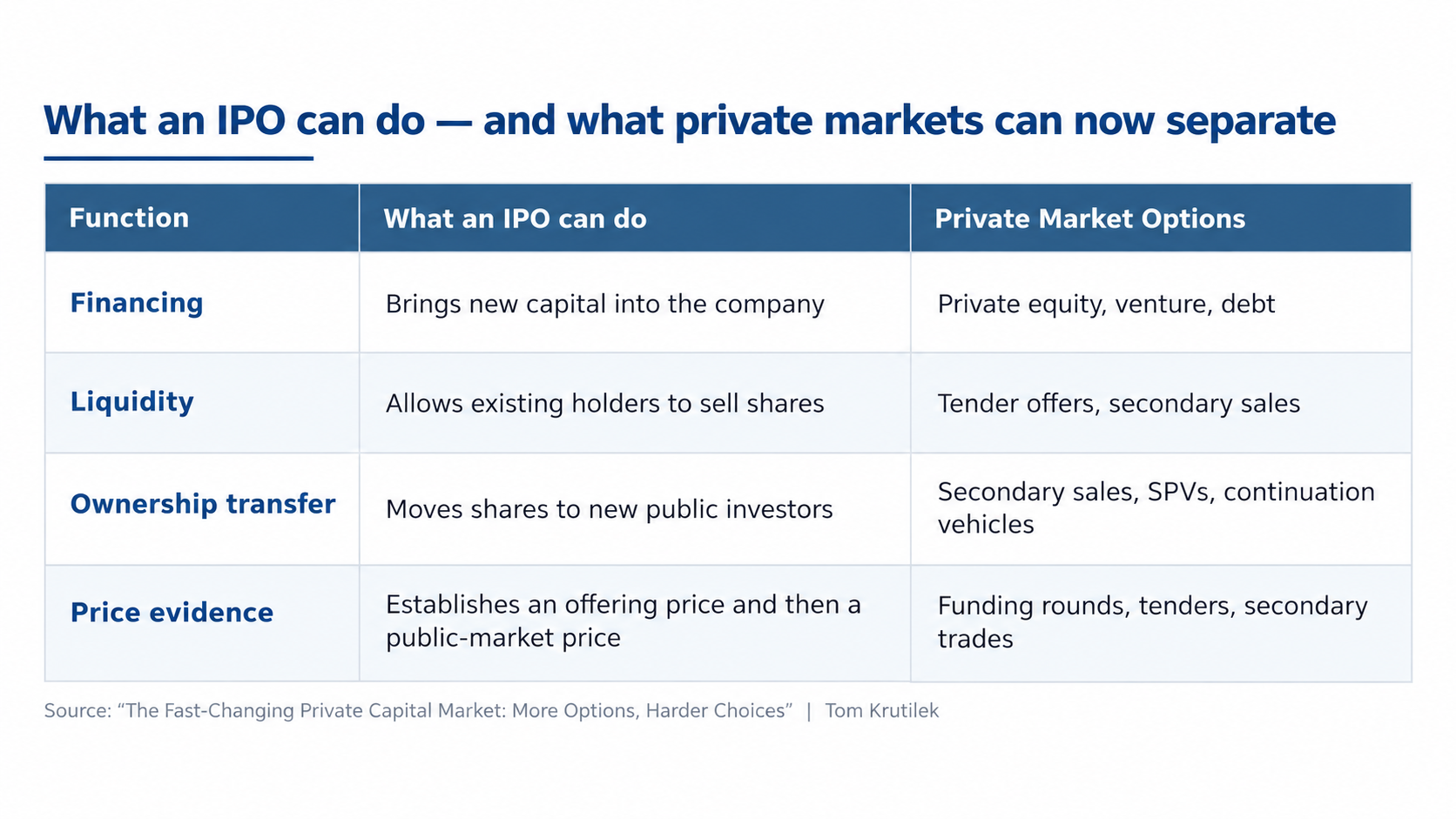
Those functions are now separating—and at a meaningful scale. Company-sponsored tenders and direct secondary sales—in which existing shares change hands rather than new shares being issued—can give employees and early investors liquidity years before an exit. Nasdaq Private Market estimates that tender offers reached about $35 billion in 2025, approaching the roughly $45 billion raised through IPOs. The comparison is imperfect: tenders provide liquidity to existing shareholders, while IPOs can also raise new capital for the company. But the scale shows how significant private liquidity has become.
Private equity has its own version. Continuation vehicles can move a company from an older fund into a new one, often managed by the same sponsor and funded by new investors. Existing investors may choose to take liquidity or remain invested. Deals led by fund managers, known as GP-led transactions, accounted for about $65 billion of a record $120 billion-plus secondary market in the first half of 2026, according to Evercore. Meanwhile, financing rounds, tenders, and secondary trades are creating more price evidence between traditional exit events.
The practical result is that financing, shareholder liquidity, and an eventual exit no longer have to occur together. Companies and investors can increasingly make those decisions separately.
Each of those options creates a harder choice.
Shareholder liquidity no longer has to wait for a company to go public or be acquired.
Harder Choice #1: Who Gets In, and Who Stays in Control?
Platforms are widening the door, and regulators have proposed widening it further. Some of the most valuable issuers are narrowing it.
Neither side is acting in bad faith; their interests simply differ. Distribution platforms want more transaction activity and broader investor access. Investors want exposure to companies whose growth increasingly occurs before any public listing. Issuers want control over who owns their shares, what information circulates about them, and how their shareholder base evolves before an exit.
Transfer restrictions, board-approval requirements, and rights of first refusal—which allow the company or existing investors to buy shares before they are sold to an outsider—give issuers tools to preserve that control. Some of the most sought-after private companies are using them.
Special purpose vehicles, or SPVs, show how quickly the distinction becomes concrete. An SPV pools money from multiple investors to gain exposure to a single company. Investors own an interest in the vehicle rather than shares directly in the company, which can mean different information rights, transfer rights, and relationships with the issuer. OpenAI’s notice, for example, specifically warns that certain SPV investments are not recognized without its consent.
For company leaders, the capitalization table, or cap table—a record of who owns the company—is no longer just a record of who invested. It increasingly reflects deliberate choices about which investors are permitted, through which structures, and at what stage of the company’s development.
Broader investor access does not necessarily mean shareholders can freely buy and sell private-company shares.
Harder Choice #2: Is There Really a Market for Your Shares?
Most coverage of private-market trading focuses on a small group of companies, and for good reason. According to data from Clarity (formerly Hiive) cited by PitchBook, the top 20 companies accounted for 81.1% of secondary trading value in the first quarter of 2026. The top five alone accounted for 44.6%.
In practice, that creates something close to two private markets. At one end, a small group of highly sought-after companies has broker quotes, recurring tenders, institutional buyers, and observable prices. Across much of the rest of the market, where most private companies operate, unsolicited secondary demand remains limited or nonexistent.
Company-level liquidity should also not be confused with fund-level liquidity. Tender offers and secondary sales may provide cash to individual shareholders—such as founders, employees, and early investors—but they have not eliminated the broader distribution shortfall facing many venture-fund investors: the shortage of cash being returned to limited partners as portfolio companies remain private longer and exits stay constrained. The PitchBook-NVCA Venture Monitor notes that this pressure persists even after a record quarter for exit value.
The private market infrastructure is reaching more companies, but often through company-managed liquidity rather than continuous trading. Liquidity is typically offered at specific times, to defined groups of shareholders, and under terms set by the company. Nasdaq Private Market reports that about half of its 2025 tender programs involved Seed through Series C companies, suggesting that structured liquidity is reaching companies earlier in their development.
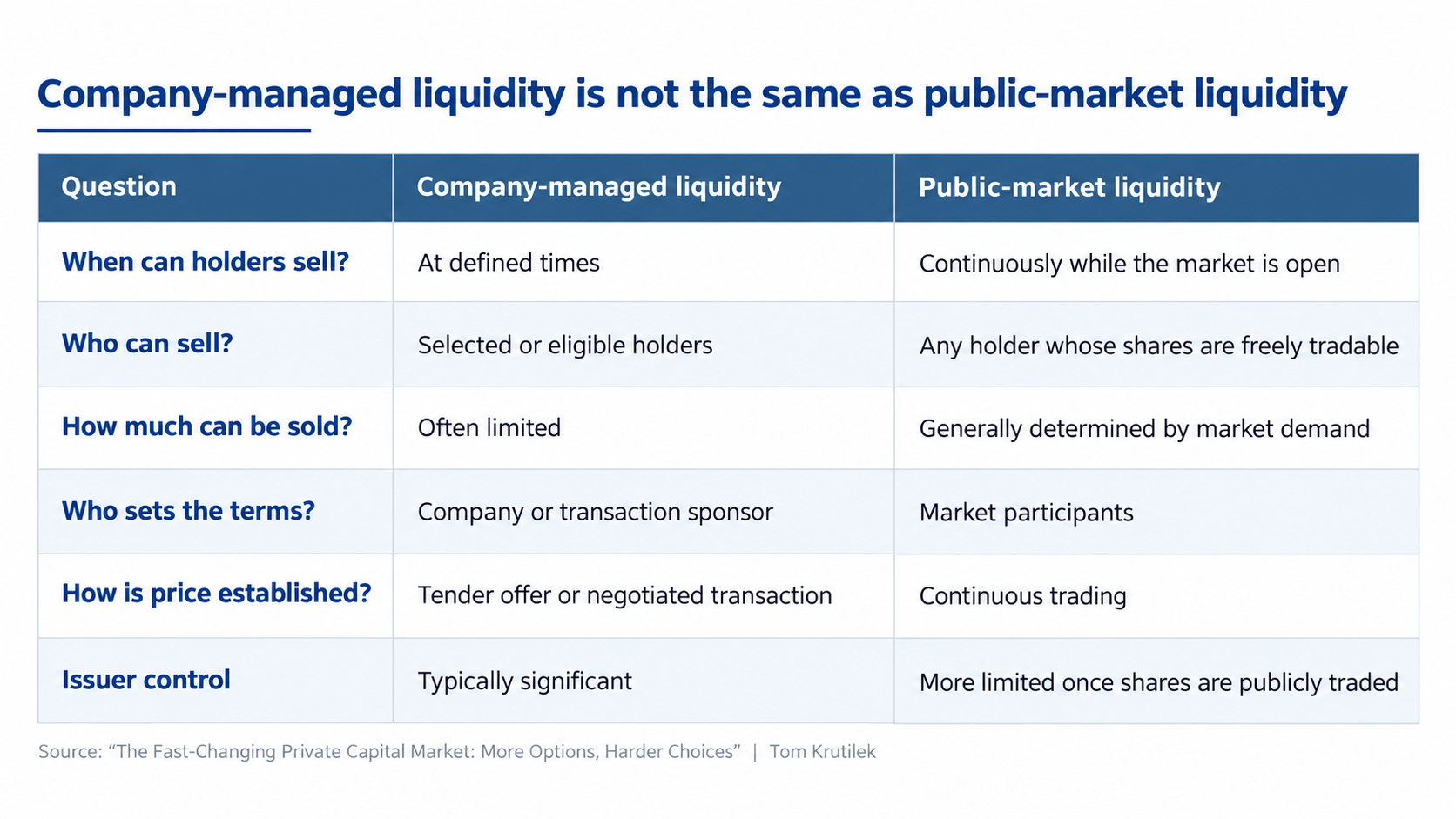
For most company leaders, the implication is that liquidity will not simply arrive on its own. It has to be designed: who is eligible to sell, how much they can sell, how often liquidity is offered, and who provides the capital to buy those shares. A lack of trading is not automatically a negative verdict on the company. It can reflect transfer restrictions, a shortage of available shares, or simply the absence of a venue.
For most companies, liquidity will come through structured programs long before anything resembling an open market.
Harder Choice #3: What Do Private Prices and Promised Liquidity Really Tell You?
More transactions create more price evidence. They do not necessarily create one authoritative price.
A secondary trade in common stock, an employee tender, an SPV interest, and a preferred-share funding round can each imply a different value for the same company because the securities, terms, timing, and transaction sizes differ. Common shares, for example, typically rank behind preferred shares in an exit, so a lower price for common stock does not necessarily mean the company’s headline valuation has fallen.
That distinction matters when an exit finally occurs. The PitchBook-NVCA Venture Monitor warns that many venture-backed companies without a path to a marquee IPO may ultimately accept exit prices well below earlier expectations. A price established in a tender or secondary trade can become a reference point, but an acquirer has no obligation to honor it. Even an IPO price is not permanent: SpaceX traded both above and below its $135 offering price within months of listing as public markets continuously repriced the company.
Liquidity carries a similar caveat. Some private-market funds offer investors periodic opportunities to sell, but that is different from having a continuously tradable investment. Interval funds, for example, typically offer to repurchase only a limited percentage of their shares at set times during the year. If more investors want to sell than the fund is prepared to buy, investors may be able to sell only part of what they requested. The lesson is simple: a liquidity feature can provide a path to cash without creating an open market.
Liquidity offered is not necessarily liquidity available when many investors want out at once.
None of this means the private-market build-out is failing. It means that new infrastructure does not eliminate the frictions of private markets. It moves them into share classes, transfer restrictions, vehicle terms, and redemption limits that investors and company leaders now have to understand.
The new private-market infrastructure doesn’t eliminate frictions. It relocates them into pricing, transfer restrictions, and liquidity terms.
Harder Choice #4: Which Route, and When?
The result is a wider menu of paths: a sale to a strategic buyer, a sale to a private equity firm, a continuation vehicle that transfers an investment into a new fund, a public listing, or staying private with company-managed shareholder liquidity.
More routes create real advantages. Early liquidity can reduce pressure on founders, employees, and early investors to seek a full-company exit simply to realize some of their investment. But the same tools can delay problems as easily as they solve them. A tender offer can temporarily support a price or valuation that the next financing may not sustain, while a continuation vehicle can either provide liquidity to existing fund investors or defer an exit the original fund could not achieve on acceptable terms.
More routes create more judgment calls about timing, structure, and trade-offs. Management has to decide which options support the company’s strategy, boards have to determine which choices require challenge or approval, and investors have to decide whether a transaction improves the economics or simply delays a harder decision.
More options do not automatically create better outcomes. They just make the choices harder.
The Choices That Matter Now
The private capital market offers more than it did even a year ago. Companies can provide liquidity without selling. Investors can reach companies that were once closed to them. Boards can weigh more paths than a single eventual exit. Those are real gains.
But each comes with choices that leaders rarely had to make independently before: who should own the company’s shares, how much liquidity to provide and to whom, how much weight to give a private-market price, and whether a transaction solves a problem or simply defers it. Wall Street is building the infrastructure quickly, and regulators have proposed widening access further. The judgment to use those tools well still belongs to each company, board, and investor.
The question is no longer only when a company will exit, but how its financing, ownership, and liquidity should evolve along the way. If financing, liquidity, ownership transfer, and exit no longer have to happen at once, management, boards, and investors have to decide how—and when—each should be used, and how those decisions should fit together.
The harder choice is no longer simply when to exit. It is how management, boards, and investors should align financing, liquidity, ownership, and exit planning over time.
#PrivateMarkets #PrivateCapital #VentureCapital #CorporateGovernance #Secondaries
References
- Morgan Stanley, “Morgan Stanley Closes Acquisition of EquityZen,” January 27, 2026.
- Morgan Stanley, “Morgan Stanley Wealth Management Reduces Fees on Private Shares Marketplace EquityZen, Broadening Private Markets Access,” February 19, 2026.
- Forge Global, “Charles Schwab Completes Acquisition of Forge Global,” March 2, 2026.
- Goldman Sachs, “Goldman Sachs Completes Acquisition of Industry Ventures,” January 5, 2026.
- OpenAI, “Unauthorized OpenAI Equity Transactions,” July 16, 2025.
- CoinDesk, “Anthropic, OpenAI tokens plunge nearly 40% as AI firms warn SPV transfers are invalid,” May 13, 2026.
- BlackRock, “BlackRock Completes Preqin Acquisition,” March 3, 2025.
- Carta, “Tender-Offer Activity Reaches a Four-Year High,” August 20, 2026.
- U.S. Securities and Exchange Commission, “SEC Proposes Amendments to Expand Responsible Retailization of Private Markets,” September 30, 2026.
- U.S. Department of Labor, “US Department of Labor proposes landmark rule to democratize access to alternative investments in 401(k) plans,” March 30, 2026.
- Alternatives Watch, “Evercore: Secondary boom continues as H1 volume exceeds $120bn,” July 21, 2026.
- PitchBook, “Q1 2026 US VC Secondary Market Watch,” 2026.
- Nasdaq Private Market, “Secondary Scene 2026 Outlook,” March 31, 2026.
- PitchBook and National Venture Capital Association, “Q2 2026 PitchBook-NVCA Venture Monitor,” July 2026.
- Forbes, “SpaceX Shares Fall Below $135 IPO Price For The First Time,” July 15, 2026.
- U.S. Securities and Exchange Commission, interval-fund registration filings describing quarterly repurchase offers and limited liquidity, 2026.
About the Author
Tom Krutilek is a Board Advisor and Chief Marketing Officer who works with early-stage and growth-stage companies on capital readiness, investor narrative, go-to-market strategy, and AI strategy and governance. His work focuses on a central question: whether growth is truly investable—not just impressive on paper.
He helps founders, CEOs, and boards connect commercial performance, capital strategy, and execution to the evidence investors need to underwrite growth. That includes strengthening the investor narrative, identifying gaps in capital readiness, building measurable growth systems, and evaluating where AI can create durable business value and competitive advantage.
Tom is also the founder of The Investor Narrative, a publication focused on private capital markets from the perspective of investor readiness. It examines the questions behind the headline numbers—how investors assess growth, capital efficiency, demand quality, competitive advantage, governance, and the assumptions that ultimately determine whether a company is ready for investment capital.